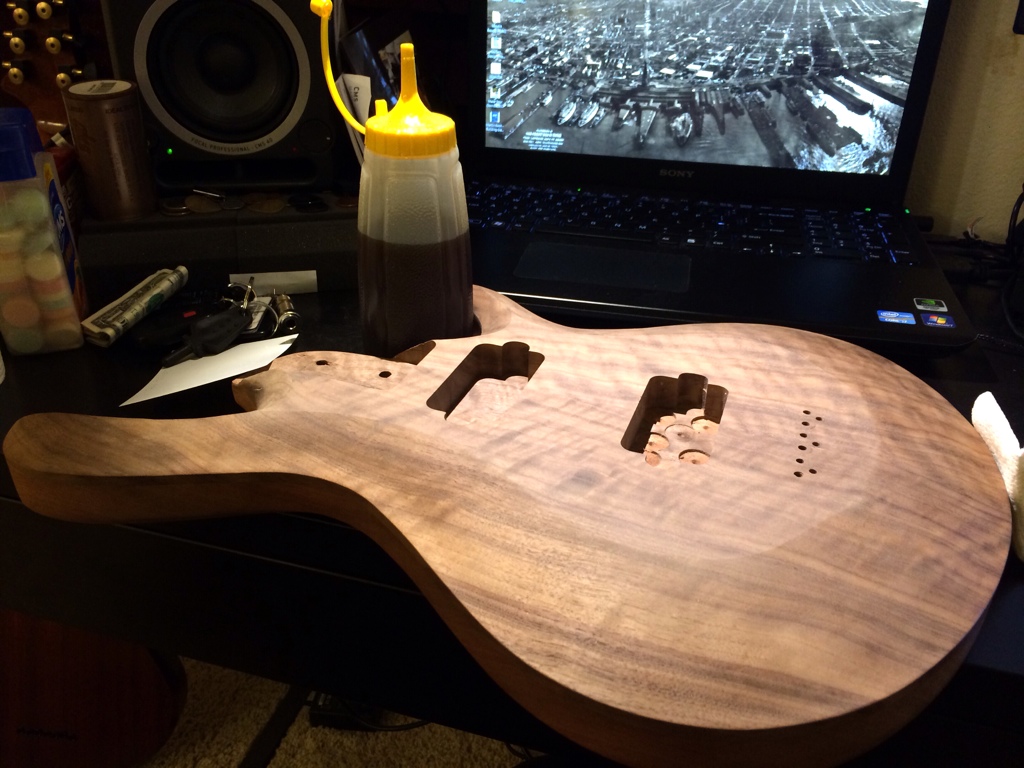
I’ve noticed that a majority of my blog traffic is from search engine hits linking to the pages where I elaborate on my finishing tips. In this post i’ll share with you my schedule that I use to finish an instrument with any of these Danish oil’s Teak oil etc. Basically any linseed based or tung based oil that has mineral spirits and other stuff in it. These all are roughly the same thing with varying parts of ingredients. Tru oil can be used in the way I describe as well but that oil will actually start forming a film, which in some cases is desirable.
The rest of these oils will simple sink into the surface leaving very little on top. This finish will leave you with practically no protection other than smudges and light scuff marks. The reason people use this finish is because it is super easy and safe; all with the added bonus that it will look pretty damn awesome. I used this finish in my most recent build
So here’s what you’ll need to do:
PREPARATION:
First prep the surface of the wood. I typically only sand till about 220, maybe 320. make sure it all looks uniform and pretty and wipe off the dust and stuff that accumulates. If you are using open pored woods then you’ll have to do the next steps a few times until the pores are clogged pretty well.
First: Soak the entire piece with oil and keep lathering it on. Once it seems pretty saturated take the next highest grit from where you left off and sand the body lightly and mash the slurry that forms into the pores, keep doing this until your arm hurts. Remember this will be a bit messy so plan accordingly. Once your arm hurts just leave the project hanging or somewhere for about an hour or two then come back and buff off as much as you can. Leave it to dry for the night.
Do this at least two more times using the same grit.
Next Do the same until you reach about 400 grit. I dont see the point in going further but you can based on how it all looks. Once you’ve reached 400 or whatever grit makes you happy, then buff it clean and let it dry for about 3-5 days depending on your humidity.
Take some high quality paste wax (I use a hard paste wax – Trewax) and swirl it on a pad and apply it liberally, really massage it in the wood. Let it sit for about 15-30 min and buff like hell. I wait a day in between and then repeat until 3 coats are on. I sometimes rub the wax in with 000 synthetic steel wool (grey scotchbrite) and then 0000 synthetic steel wool (white scotchbrite wood sanding pad) for the final coat and then im all done.
Its basically an infinitely repairable finish and will age really well. you’ll know you’ve done it right because it’ll feel smooth and it’ll have a very high sheen. The great thing about this is the beauty and depth/chatoyance is retained without many layers of lacquer. If this has been any help to any of you please comment with a link to your finished product. I’d love to see it.
 Lutherie...
Great article! Thank you! Very helpful.
hello and thanks for some interesting advice on using danish oil.. i have been building celtic harps for a few years now and normally use polyurethane varnish mainly for durability. My last harp was made from local european walnut which has a wide colour variation so i used danish oil to attempt to even the colour. The result was beautiful the colour darkened a little and the grain really expressed itself. Some people have advised on not using oil finishes on harp necks as it may lubricate the tuning pins passing through the neck which rely on friction for stable tuning. I use threaded not tapered pins and they seem to be working fine. Any ideas on whether the varnish content in danish oil reduces the lubrication risk. i am just about to finish a hammer dulcimer with walnut sides and back so i am tempted to use danish oil again but dont want to risk the performance of the 66 zither pins used for tuning.. Any advice or info would be greatly appreciated…
Hi! thanks for the informative post. I’m thinking of using Danish oil for a tele build i’m busy with. I was wondering if you do the same to the neck? I have a maple neck with maple fretboard, and I think it would look great having the neck lighter than the body. I am assuming the ash body is going to change colour to the beautiful brown shown in your example.
What would you recommend for the neck if not danish oil?
Yup you could use the oil or just sand to about 320 uniformly and then go with a straight wax finish. I just did that on a build and it worked great. I think I did two coats and buffed off. Didn’t darken the wood much but will offer some moisture protection
Hi. Great finish. You mention for this project “these finishes”. Which one did you actually use?
Sorry for some reason this comment missed my inbox! I’ve used watco danish oil, deft danish oil, formsby tung oil (I think it forms a film finish and has plasticisers), waterlox red can (looks beautiful but smells like death and takes forever to gas off), tried and true danish oil, and another one I can’t remember the name. Now I’ve been using odies oil because it doesn’t take as much work to get the same if not better results.
Hi, U r writting about hand sanding. Can sander be used witch 320 on, instead of manual sanding ?
I think so. I usually go by hand but if you’re careful then I don’t see why it wouldn’t work. My fear is because machine Sanders can be aggressive sometimes
Thanks for quick answering !
So am I getting this right; You put oil on, and then sand while its wet? Great guide otherwise! Nice finish you got there 🙂
yup yup.
the idea is to create a slurry. basically when you sand with oil the sawdust and oil mix together and form a very thin paste which deposits itself into any open pores.
the more you do this the flatter the surface becomes. then when you’ve reached the higher grits, it feels as smooth as glass. honestly its really worth the trouble. it feels wonderful to touch and doesnt feel like a thick coat of lacquer.
after you get it to where you like then wax it a few times and then bufff. then you’re done!
Some people dont like to close the pores, in that case just wipe on and let sit. then wipe off after about 30 min or so. and keep wiping off the oil that oozes out as well.
Hope this helps!